ISMPH Charts New Strategic Direction, Targets Greater Influence in African Public Health

By Ojoma Akor
ABUJA — The International Society of Media in Public Health (ISMPH) has unveiled plans to reposition the organization as a stronger, more visible and influential African institution for strategic communication, public health advocacy, knowledge and media engagement.
The plans were outlined during a one-day strategic staff retreat in Abuja, where the organization’s leadership challenged staff to move beyond project-based interventions to build institutional expertise, influence, and sustainable impact.
The Executive Director and Founder of ISMPH, Moji Makanjuola, said the organization was founded in 2010 on the conviction that the media could do more than report public health issues.
According to her, the media could shape conversations, influence policy, mobilize communities, drive behavioral change and ultimately contribute to improved health outcomes.
Makanjuola said that over 15 years, ISMPH had advanced public health advocacy, strengthened communication, supported health systems, engaged the media, transformed communities and contributed to policy conversations across areas including primary healthcare, maternal and child health, cancer, health financing, child spacing, empowerment, clean air and development.
She described the organization’s continued relevance as one of its greatest achievements, noting that ISMPH had built relationships with governments, development partners, civil society organizations, the media, traditional and religious leaders, opinion leaders and communities.
However, she said the organization could not define its future by its current projects, funding, geographical reach, or capabilities.
“I want us to become a recognized African institution for strategic communication, public health advocacy, knowledge, media engagement and development solutions,” she said.
From projects to policy influence
Makanjuola urged staff to think beyond individual projects and work toward a progression from projects to programs, expertise, influence, and ultimately policy and systems change.
She identified new geographies, partnerships, thematic areas, funding opportunities, and areas of expertise as priorities for the organization’s next phase.
The Executive Director also acknowledged challenges facing ISMPH, including funding constraints, a competitive development environment, capacity and systems gaps, coordination and communication challenges, inconsistency, reactive approaches, and missed opportunities.
She stressed, however, that the challenges should be viewed as opportunities for innovation and institutional growth rather than failure.
“We must turn challenges into stepping stones, limitations into innovation and gaps into opportunities,” the presentation stated.
She outlined a repositioning agenda that includes rebranding the organization, strengthening internal systems, building staff capacity, improving visibility, expanding fundraising, developing partnerships, documenting impact, and embracing technology.
Makanjuola also called for a change in staff mindset—from asking “What is my job?” to asking “What can I contribute to making ISMPH stronger?”
She said the changing nature of technology, media, public health, the development sector and funding models required staff to acquire new knowledge and skills continuously.
“Reputation takes years to build and moments to damage, especially in this age of technology,” she warned, stressing the importance of honesty, accountability, professionalism and respect.
She outlined a vision for an ISMPH with stronger funding, bigger programs, greater visibility, stronger technical expertise, wider partnerships, and greater influence beyond Nigeria.
The ultimate goal, she said, was to build “an African institution of reference.”
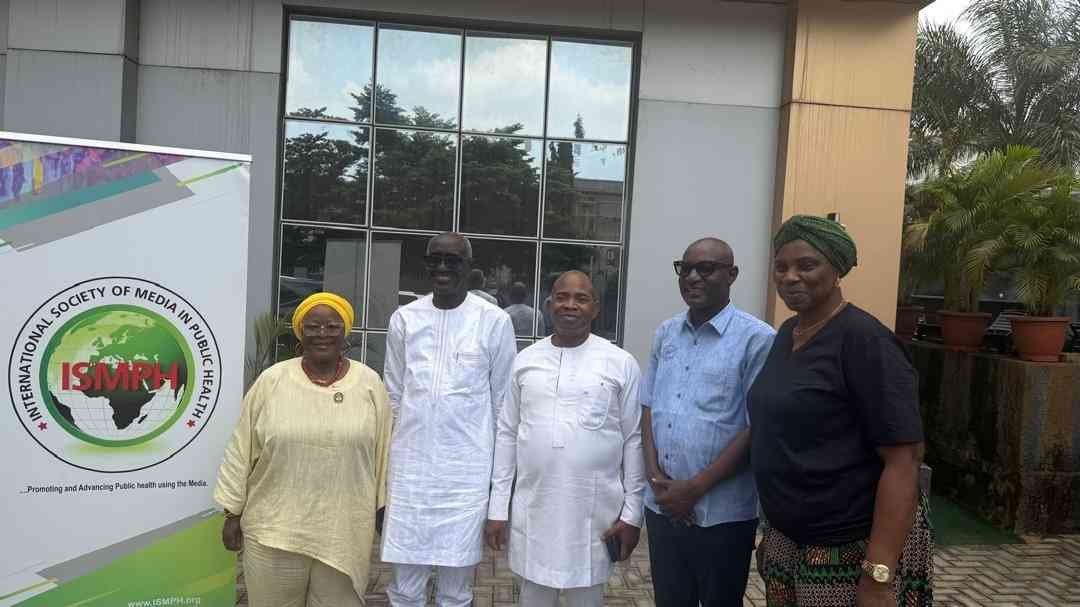
ISMPH sets short-term strategic priorities
The Director of Programs, Solomon Dogo, in his presentation, “Strategic Reflections and Projections for the International Society of Media in Public Health,” said the organization’s media mainstreaming agenda was designed to facilitate the dissemination of healthcare information, support service delivery and accelerate development nationally and internationally. Its work, he noted, revolves around research, advocacy and engagement as initiators, partners and executors.
He identified public health priorities including disease prevention and control, promoting healthy living, and addressing the social determinants of health, alongside reproductive, maternal, newborn, child and adolescent health and sanitation.
For the short term, Dogo proposed enhanced staff capacity building through knowledge-sharing sessions, webinars, and conferences.
He also called for improved funding and partnerships through bilateral and multilateral cooperation, and urged ISMPH to promote competence in health reporting through workshops, fellowships, and exchange programs.
Other priorities include mobilizing urban and rural communities for health interventions, strengthening advocacy for greater synergy between public and private health intervention agencies, and promoting better deployment and utilization of resources.
Dogo also proposed advocating for a Legislature-Civil Society Forum on Health to strengthen legal frameworks and improve oversight of health budgets, projects, and programs.
He stressed that public health is inherently multisectoral and that the media has a pivotal role not only in creating awareness but also in generating targeted interventions that improve population health.
He said the retreat’s resolutions and commitments should guide ISMPH toward greater efficiency and effectiveness, leading to improved program outcomes over the long term.
Accountability, performance and new media
An ISMPH board member, Dr Abubakar Jimoh, reaffirmed ISMPH’s mission of positioning the media as a transformative force for accelerating public health information and outcomes, with a vision of an informed public empowered to make evidence-based health decisions.
He identified advocacy, capacity building, and equitable and ethical health communication as core organizational objectives.
According to him, programs and campaigns must be delivered against approved work plans, while media partnerships, stakeholder engagement, visibility, and reputational gains should be systematically documented.
He called for clear deliverables and timelines for each unit, performance indicators aligned with ISMPH’s strategic objectives, and regular reporting to track progress and identify risks early.
Jimoh also advocated periodic SWOT analyses to guide strategic decisions and resource allocation, along with stronger internal systems, controls, and operating processes.
He urged the organization to preserve institutional knowledge and build on past successes rather than starting afresh with every new program cycle.
He further called for broader coalitions and stronger synergy with partners and Ministries, Departments and Agencies (MDAs), supported by consistent storytelling, strategic media placements and sustained press engagement.
A key element of the strategy, he noted, would be maintaining a firm hold on news and social media as ISMPH seeks to position itself as a reference point in media and public health.
Health journalists urged to make television reporting more accessible
Alhaji Danjuma Abdullahi, in his presentation focused on “Strategic TV Production for Health Journalists,” noted that professionals involved in public health communication have a responsibility to translate complex medical and scientific information into clear, reliable, and accessible stories that build public trust and influence policy.
He said health journalists should be able to transform complex research findings, disease trends and health financing figures into clear narratives, including through infographics and data visualization.
Drawing on the WHO principles for effective health communication, he highlighted six key requirements for health television reporting: accessibility, actionability, credibility, relevance, timeliness and understandability.
He urged journalists to reach audiences who need health information; use appropriate platforms and local languages; provide clear steps people can take; rely on evidence and expert sources; address issues relevant to their audiences; and deliver information when people are making health decisions.
He also stressed the importance of simple language and effective visuals, cautioning journalists against unnecessary jargon and encouraging graphics to make health information easier to understand.