Breast cancer: Inside Nigerian women’s struggles for survival
By Ojoma Akor
CHINEDU Mike lost his 42-year-old wife to breast cancer some months ago, leaving him with four children to care for amid mounting debts. He said their ordeal began three years earlier when she was diagnosed with the disease, forcing her to abandon work for extended periods as her health deteriorated.
“It was particularly difficult because there was no major public hospital in our local government area, so she had to travel to the state capital for treatment. She was later referred to a hospital in Abuja, where she had to relocate temporarily, staying in hotels and with relatives as our money ran out. Despite all our efforts, she still died,” he said.
Similarly, Fatima Nuhu lost her 45-year-old sister to breast cancer in March this year after a five-year struggle with the disease. She said her sister underwent a mastectomy and subsequently required chemotherapy and radiotherapy, with the family initially bearing the treatment costs.
However, as her savings dwindled, they resorted to public appeals and social media fundraising to raise money for her care.
“There were times her treatment was interrupted for weeks and months because of delays in accessing radiotherapy and because she could no longer afford it. Whenever we managed to raise some money, she resumed treatment. Despite five years of struggle and painful treatments, the doctors eventually told us the cancer had spread to other organs,” she said.
Temitayo also lost her 60-year-old mother to breast cancer in last year, despite an early diagnosis at stage two. She said the family struggled to keep up with the cost of treatment, particularly chemotherapy medicines.
“We thought we were lucky when her cancer was diagnosed at stage two, but we still lost her within three years. At one point, I went to buy medicines prescribed for her chemotherapy at a pharmacy and was shocked when I was told they cost ₦1.5 million. I had expected about ₦200,000, so I had to turn back. We, her children, eventually had to contribute the money for her treatment,” she said.
Her mother’s condition later deteriorated, leaving her unable to walk and dependent on a wheelchair after the cancer spread to her spinal cord. The family eventually took her to the village, where they sought help from prayer houses and herbalists before she died.
Mustapha Ibrahim was just 14 years old when he lost his mother, a single parent of two, to breast cancer seven years ago. His younger brother was 12.
He recalled how his mother frequently wept during her illness, expressing her fear of dying and leaving her children behind.
“She kept saying, ‘I don’t want to die and leave my children. I want to live for my children.’ She had been diagnosed less than a year before she died,” he said.
Following her death, the two boys had to leave Abuja to live with relatives in Okene, Kogi State, for a year before Mustapha eventually secured a menial job.
Juliana Omotayo, a civil servant, said she shed tears endlessly during the service of songs for her late friend in July this year. She was the third woman close to her who died of breast cancer this year alone. All three women were under 50. After attending a free medical outreach where she was advised to undergo a mammogram, she became anxious when further tests led to a recommendation for a biopsy.
“I was afraid because of the number of people around me that have died of breast cancer. When my biopsy result came back negative, I danced. However, some people I know are still struggling with the financial burden of breast cancer treatment,” she said.
While some women die from breast cancer, others survive the disease, although the journey through diagnosis and treatment can be prolonged and challenging.
Gloria Orji, a breast cancer survivor, said she was diagnosed with the disease in 2010 but experienced a recurrence in 2018, requiring her to undergo treatment again

Gloria Orji
“My experience with breast cancer is horrible. I underwent chemotherapy and radiotherapy and was placed on hormonal medication for five years each time. Altogether, I spent 10 years on hormonal treatment. When I was going through the treatment, I was praying, and at the end of it, God came through for me, and I came out well. Despite the challenges, I followed through with my doctors’ recommendations, which helped me survive,” she said.
Another survivor, Gloria Okwu, said her experience began in 2016 when she discovered a lump in her left breast. Seven months later, following scans, a mammogram and a biopsy, she was diagnosed with breast cancer.
She subsequently underwent a mastectomy, more than 25 sessions of chemotherapy, about 35 sessions of radiotherapy and targeted therapy.
Okwu said accessing treatment was complicated by inadequate health infrastructure, the high cost of care, a shortage of qualified oncologists due to brain drain, limited access to treatment equipment and insufficient psychological support.
58 women die from breast cancer in Nigeria daily
An estimated 58 women die from breast cancer in Nigeria daily. Medical experts say the actual number is higher. They describe the current cases and death rate from breast cancer in the country as alarming.
Medical experts, survivors and families who have lost relations to the disease have called for urgent action to stem the alarming death rates and cases.
What you should know about breast cancer
The World Health Organization (WHO)) describes breast cancer as a disease in which abnormal cells in the breast grow out of control and form tumors. If left unchecked, the tumors can spread throughout the body and become fatal.
Medical experts say symptoms of breast cancer include a lump or swelling in the breast or armpit, unusual nipple discharge, changes in the size or shape of the breast, nipple inversion, persistent breast or armpit pain, and changes in the skin of the breast.
Usman Samuel Nganjiwa, a general surgeon and breast cancer specialist at the University of Maiduguri Teaching Hospital, Borno State, explained that although a breast lump is a common symptom, its absence does not necessarily rule out cancer.

Dr Usman Samuel Nganjiwa
“Sometimes you may not feel that lump; there may be nipple discharge. There may be disparity between one breast and the other, or in some people, one breast becomes bigger than the other, and the affected breast may actually be shrinking rather than swollen. Another symptom the patient may report is that the nipple is going inward rather than outward. We call it nipple retraction,” he said.
Nganjiwa, who is also the State Coordinator of Cancer Consciousness Initiative (CCI)/TeleOncology, added that other warning signs could include skin changes resembling an orange peel, dimpling, non-healing wounds on the breast, and persistent pain and swelling in the armpit, urging women who notice such changes to seek medical evaluation.
On the risk factors, the doctor said there is no single known cause of breast cancer, but family history and inherited genetic mutations, particularly BRCA mutations, can increase a woman’s risk.
He explained that women with a family history of breast cancer, especially among close blood relatives such as mothers, sisters and grandmothers, should be particularly conscious of their risk and seek appropriate medical advice.
The experts said while breast cancer is more common in women, men also suffer from breast cancer.
He said he attended to one or two breast cancer cases at his health facility every week, adding that his youngest patient was a 14-year-old girl whom he had recently seen.
Burden of breast cancer
According to the latest Global Cancer Observatory (GLOBOCAN 2024) Nigeria Fact Sheet (IARC/WHO), the top three most common cancers in Nigeria are breast cancer, prostate cancer, and cervical cancer.
Breast cancer ranks first among the three as Nigeria recorded an estimated 44,196 new cases of breast cancer and 21,309 deaths in 2024.
Explaining the GLOBOCON data, Ifeoma J. Okoye, an emeritus professor, physician, and global health leader, said, “Breast cancer is now the most common cancer in our country, accounting for 29 per cent of all new cancers, and almost half (49.3 per cent) of all cancers in Nigerian women. It is also our leading cancer killer, responsible for nearly one in every four cancer deaths.
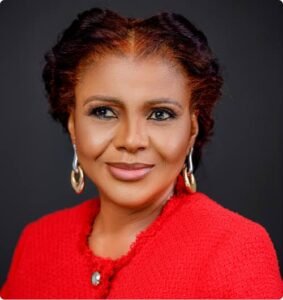
Professor Ifeoma Okoye
“Let me put that in human terms. On these estimates, a Nigerian woman is diagnosed with breast cancer roughly every 12 minutes, and one dies from it roughly every 25 minutes.”
She added, “Two years earlier, GLOBOCAN 2022 (IARC/WHO) estimated 32,278 new cases. Some of that increase reflects population growth and improved estimation methods. Still, the direction of travel is unmistakable, and it matches what population-based registries in Nigeria have been reporting for more than a decade: breast cancer incidence is rising.”
Underreporting of breast cancer cases in Nigeria
Asked why the actual number of breast cancer cases and deaths in Nigeria could be higher than official estimates, Okoye said many women were not captured in the statistics because they did not visit health facilities where their conditions could be confirmed through biopsy.
She explained that some women sought treatment at herbal homes, prayer houses and patent medicine shops, while others died at home without receiving a formal diagnosis or medical certification.
She also identified gaps in the country’s cancer registration system, noting that registries are not evenly distributed across Nigeria, with rural communities, northern states and conflict-affected areas particularly under-represented.
According to her, national estimates are therefore modeled using data from a limited number of cancer registries, meaning that many cases may remain undocumented.
“What I see in clinics confirms it. Far too many of the women we meet have lumps they have carried for months, sometimes years, before anyone examined them,” she said.
She added that cancer had become a notifiable disease in Nigeria, requiring public and private health facilities to report every diagnosed case to the National Institute for Cancer Research and Treatment (NICRAT).
Nigeria records high number of cancer cases, deaths
A major analysis published this year in The Lancet Oncology, based on the Global Burden of Disease Study, revealed a sharp increase in breast cancer incidence among Nigerian women. The study found that the incidence rate rose by 145.5 per cent, from 54.3 cases per 100,000 women in 2010 to 133.3 cases per 100,000 in 2022.
Experts say Nigeria continues to record an alarming number of breast cancer deaths, with late diagnosis and delays in accessing treatment contributing significantly to poor outcomes.
Okoye said that, according to GLOBOCAN 2024 estimates, about 48 out of every 100 Nigerian women diagnosed with breast cancer are expected to die from the disease. She attributed the high mortality to women being diagnosed too late and either receiving delayed treatment or having no access to treatment.
Evidence from a study conducted at the University College Hospital (UCH), Ibadan, further highlights the country’s poor survival outcomes. The study found that only 37.6 per cent of women who received optimal treatment were alive five years after diagnosis. More than half (55.3 per cent) presented with stage III breast cancer, while 28 per cent already had advanced disease that had spread to other parts of the body.
The disparity in survival outcomes is also reflected in a study titled Achieving World Health Organization Global Breast Cancer Initiative Targets: A Situational Analysis and Action Plan in Nigeria, which reported that breast cancer survival in Nigeria is approximately 36 per cent, compared with 90 per cent in the United States.
Okoye said the impact extends beyond the affected women, noting that breast cancer often strikes during their most productive years, when they are raising children, running businesses and providing for their families.
“When a mother dies of breast cancer, the whole family pays the price,” she said.
Factors fueling breast cancer cases, deaths in Nigeria
Okoye said several factors contribute to the rising burden of breast cancer in Nigeria, including changing lifestyles, inherited genetic mutations and the increasing number of younger women being diagnosed with the disease.
She explained that changes in reproductive patterns, such as having fewer children, delaying childbirth and shorter breastfeeding periods, contribute to breast cancer risk. Other factors include increased consumption of processed foods, physical inactivity, obesity and alcohol use.
Genetic predisposition is another concern. A study involving 1,136 Nigerian women with breast cancer in Ibadan found that about 14.7 per cent had inherited mutations, mainly in the BRCA1 and BRCA2 genes, highlighting the importance of family history and genetic factors in the disease.
Okoye also noted that Nigerian women tend to develop breast cancer at a younger age than women in high-income countries, with the average age at diagnosis estimated at 47 to 48 years. She added that nearly half of the women in the Ibadan genetic study had triple-negative breast cancer, an aggressive form of the disease.
However, she said the high mortality rate is driven largely by late presentation, delays in diagnosis, unaffordable treatment, inadequate medical infrastructure, myths and stigma, and shortages of cancer specialists.
According to her, Nigeria’s 2025 Cancer Control Capacity and Needs Assessment found that more than 70 per cent of cancer patients present with advanced disease.
She cited a 2025 study involving 264 cancer patients in Kano and Ibadan, which found that the median time between first noticing symptoms and receiving a diagnosis was 12 months. Patients visited a median of three health facilities before obtaining a diagnosis.
Another study in Ilesa, Osun State, found that women who first sought help from herbal homes took an average of 89 weeks, nearly two years, to reach cancer treatment and often presented with more advanced tumors.
Okoye said fear, myths and stigma also contribute to delays, as some women believe breast lumps are spiritual attacks, fear that biopsies spread cancer or regard a cancer diagnosis as an automatic death sentence. Others delay seeking care because of concerns about losing a breast or their husbands’ reactions.
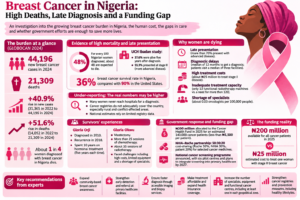
Infographic on Nigerian breast cancer burden. Credit: ChatGPT
The cost of breast cancer treatment
The cost of treatment presents another major barrier. Okoye estimated that treating stage II breast cancer in Nigeria could cost about ₦25 million, with most families paying out of pocket. Consequently, some patients interrupt or abandon treatment when they run out of money.
Nigeria also faces severe shortages of cancer treatment infrastructure and specialists. According to the medical practitioner, the 2025 national assessment found that the country had only 13 functional radiotherapy machines, compared with an estimated need of more than 120, while the number of oncologists stood at about 0.03 per 100,000 people.
She added that access to mammography, breast ultrasound, biopsy services, and receptor tests needed to guide treatment remains concentrated in major cities, making timely diagnosis and treatment difficult for women in underserved communities.
Nganjiwa also identified low awareness and misinformation as factors contributing to late presentation, saying some women initially attribute breast changes to spiritual attacks or traditional causes rather than seeking medical attention.
He stressed that early detection and adherence to medical treatment could improve survival, citing a patient he had managed for about 20 years after she presented with breast cancer at an early age.
He also highlighted the financial burden of treatment, noting that some targeted therapy medicines could cost as much as ₦2.5 million per course, making sustained treatment difficult for many families.
How Nigeria can tackle rising breast cancer cases and deaths
Experts say reducing breast cancer deaths in Nigeria will require stronger community awareness, early detection, affordable treatment, improved healthcare infrastructure and sustained government investment.
Nganjiwa said there was a need to take breast cancer education beyond hospitals and reach women in schools, religious centres, markets and communities. He also called for cancer care to be decentralised, with primary and secondary healthcare facilities equipped to support early detection, diagnosis and referral.
He further advocated establishing at least one specialised cancer centre in each geopolitical zone to improve access to treatment and reduce the burden on patients who currently travel long distances for care.
In the same vein, Okoye outlined several measures she said could help reverse the trend. She called for breast cancer awareness programmes to be expanded beyond October campaigns and major cities to reach women in rural communities through churches, mosques, traditional institutions, schools and women’s groups.
She also advocated strengthening primary healthcare facilities by training nurses and community health workers to conduct clinical breast examinations and promptly refer women with suspected breast cancer for further evaluation.
To address delays in diagnosis, she recommended establishing well-equipped breast clinics in every geopolitical zone where women could access imaging, biopsies, and receptor testing in one location, reducing the time between presentation and diagnosis.
On treatment affordability, she called for expanded National Health Insurance coverage for breast cancer, increased funding for the Cancer Health Fund and guaranteed access to essential medicines. She also urged the government to expand radiotherapy services and ensure that machines are adequately staffed and maintained.
Okoye further stressed the need to strengthen cancer workforce capacity by training and retaining more radiologists, radiographers, pathologists, surgeons, oncologists, medical physicists and oncology nurses, particularly outside major cities.
She also called for stronger cancer registration systems, urging public and private health facilities to comply with mandatory cancer notification requirements so that national data could better reflect the actual disease burden.
On prevention, she encouraged women to maintain healthy lifestyles through regular physical activity, healthy weight management, limiting alcohol consumption, and breastfeeding.
She advised Nigerian women to pay attention to changes in their breasts, including lumps, changes in shape, skin dimpling, unusual nipple discharge, and nipple inversion, and to seek medical attention promptly when they notice any of these symptoms.
Gloria Orji, a survivor, recommended rigorous research that will unravel some solutions to reduce breast cancer.
Another breast cancer survivor, Gloria Okwu, said Nigeria needs to improve access to and affordability of all aspects of cancer care.
Need for stronger government intervention and sustainable breast cancer funding
The Cancer Health Fund (CHF), established under the Federal Government’s 2020 Appropriation Act, was designed to provide financial support for indigent cancer patients, including those with breast, prostate and cervical cancers.
Though some patients benefitted, findings indicate that its implementation has faced several challenges, including inadequate funding, delayed or unsuccessful enrolment of applicants, limited access to essential medicines, and coverage restricted to only six treatment facilities in the country. Some breast cancer patients also reported difficulties accessing prescribed medicines, including zoladex.
Okoye said Nigeria needs a dedicated intervention fund for breast cancer, adding that it should be ring-fenced within the existing national cancer control framework rather than established as a separate programme.
In 2025, only ₦200 million was appropriated for the National Cancer Health Fund, which experts say is insufficient for an estimated 140,000 cancer patients nationwide.
This amounts to less than ₦1,500 per patient, compared with the estimated ₦25 million required to treat a woman with stage II breast cancer.
“No amount of awareness can save a woman who cannot afford her treatment,” Okoye said.
Efforts to ease the financial burden through the National Health Insurance Authority (NHIA) have also provided limited relief.
The NHIA, in partnership with Roche, a global pharmaceutical company, introduced a cost-sharing arrangement for selected oncology medicines under which Roche covers 50 per cent of the cost, the NHIA contributes 30 percent, while patients pay the remaining 20 percent. However, some survivors and patients said even the 20 per cent contribution remains unaffordable.
The NHIA Director-General, Kelechi Ohiri, a doctor, said the partnership was designed to reduce the cost of selected cancer medicines for eligible insured patients.
Meanwhile, officials of the National Institute for Cancer Research and Treatment (NICRAT), led by its Director-General, Usman Malami-Aliu, a professor, did not respond to messages and calls seeking comments on government efforts to reduce the breast cancer burden and the state of the Cancer Health Fund.

NICRAT DG, Professor Usman Malami-Aliu
Government’s national cancer screening programme
Earlier this year, the Federal Ministry of Health and Social Welfare announced plans to establish a national cancer screening programme to expand access to early detection services.
Speaking during the flag-off of a nationwide free cancer screening programme, the Minister of State for Health, Iziaq Adekunle Salako, a doctor, said the government had commenced a pilot programme of preventive oncology clinics in six centres across the country.
He said the government intended to integrate basic cancer screening services into primary healthcare centres before the end of President Bola Tinubu’s first term in May 2027.
However, a study titled Prospects for Population-Based Breast Cancer Screening in Nigeria: An Integrative Literature Review found that although Nigeria’s National Cancer Control Plan (2023–2027) provides for a national breast cancer screening programme, implementation remained at the planning and early pilot stages, with no coordinated nationwide rollout at the time of the study.
Republished from the International Center for Investigative Reporting (ICIR)