CSOs urge Nigeria to institutionalize health reforms, strengthen financing accountability
By Ojoma Akor
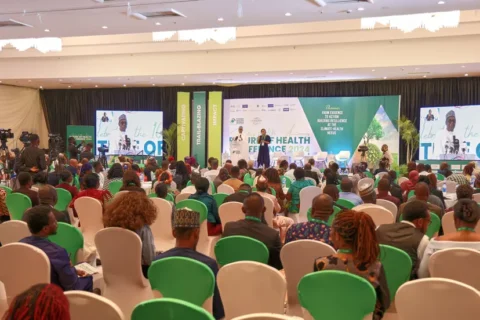
ABUJA, Nigeria — Civil society organizations (CSOs) have called on the Nigerian government to institutionalize ongoing health reforms and improve transparency in health financing.
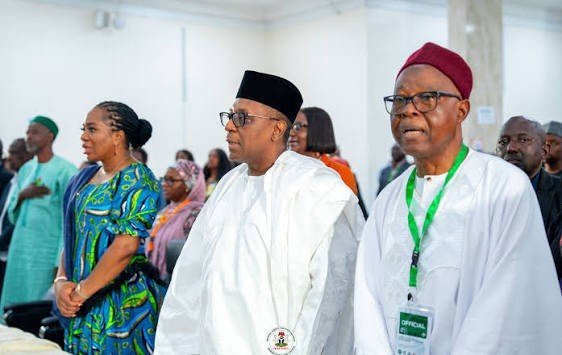
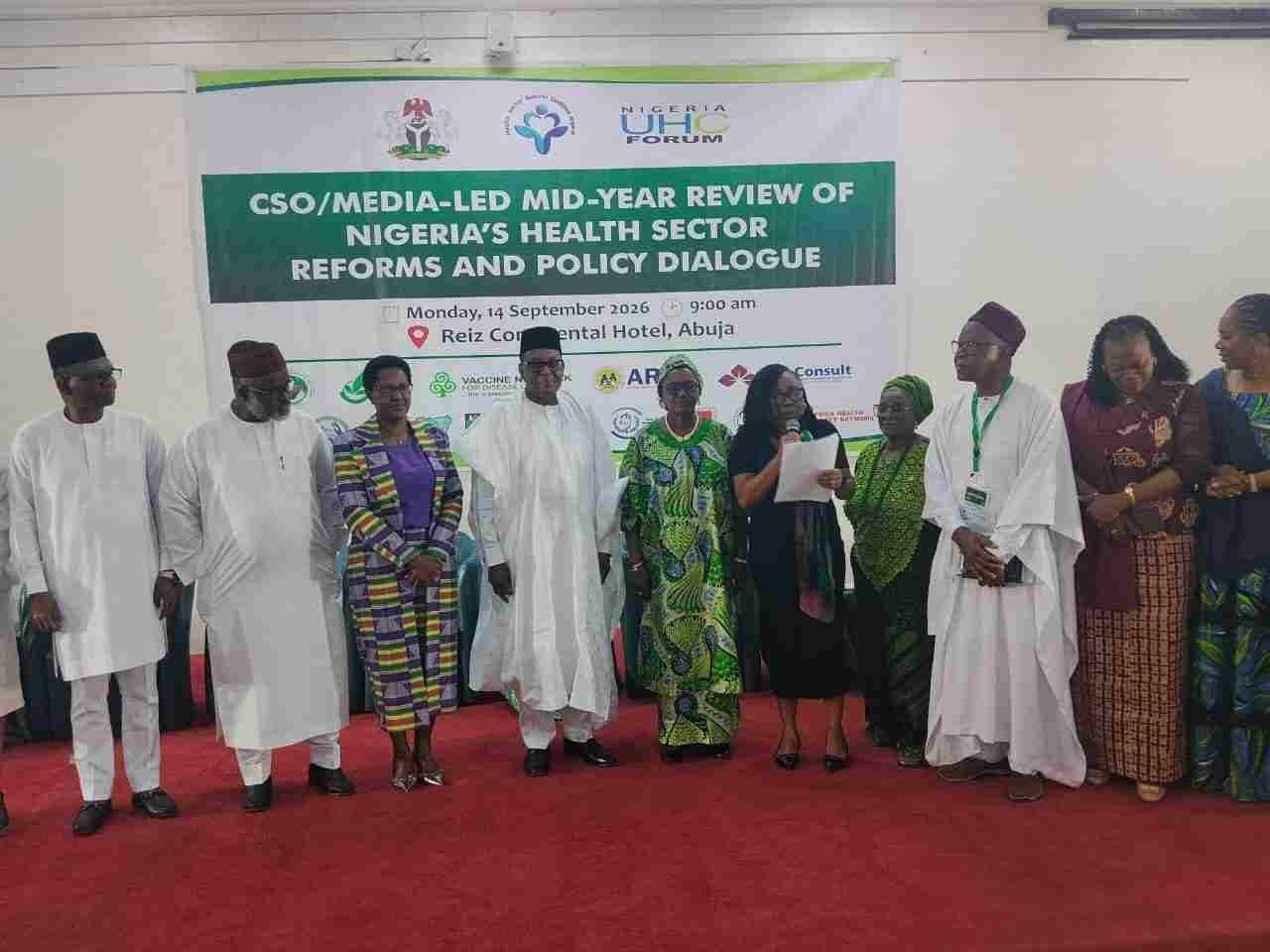
The Health Sector Reform Coalition (HSRC) and other civil society organizations made the call on Monday during a high-level civil society and media engagement on Nigeria’s health reforms.
Presenting the civil society organizations’ mid-term position on the country’s health reform program, Dr. Muhammed M. Lecky, Chairperson of the HSRC, said the current reform agenda had created an important framework for addressing longstanding fragmentation in Nigeria’s health sector.
He said the Health Sector Renewal Investment Initiative and the Sector-Wide Approach (SWAp) had strengthened coordination among federal and state governments, local government areas, development partners and communities.
According to him, the principles of “one plan, one budget, one report and one conversation” provide a foundation for improved coordination and accountability across the health sector.
However, the CSOs said the next phase of the reforms must focus more strongly on translating policy and investment into measurable improvements in people’s lives, particularly among underserved populations.
He said, “At this mid-term point, our central question is straightforward: Are the reforms sufficiently financed, institutionalized, broadly owned and implemented to produce sustained improvements in the lives of Nigerians?”
The organizations said the reforms were moving in a positive direction but stressed that gains needed protection, strengthening, and translation into results.
PHC functionality should replace renovation figures
The civil society organizations welcomed investments in the rehabilitation and revitalization of primary healthcare centers (PHCs), including the use of Direct Facility Financing under the Basic Health Care Provision Fund (BHCPF).
But they urged the government to move beyond counting renovated facilities and instead measure how many facilities are consistently functional and can provide quality care.
They said, “A functional PHC should have appropriate health workers, essential medicines, basic diagnostics, electricity, water, infection prevention systems, referral arrangements, maternal and child health services and accessible feedback mechanisms.”
They said that a renovated facility without the staff, medicines, electricity, and systems required to provide care should not be considered fully functional.
The CSOs identified rural communities, poor households, conflict-affected populations, displaced persons and other hard-to-reach groups as populations that often face greater barriers to healthcare.
They called for reform success to be measured by whether these groups experience improvements in access, quality of care, financial protection and health outcomes.
They also urged the government to use disaggregated data at state, local government, ward, and facility levels to target resources to underserved communities.
Financing remains a major concern
The CSOs also identified high out-of-pocket expenditure, delayed fund releases, fragmented financing flows, and continued dependence on external funding as challenges requiring greater attention.
They called for timely release of appropriated health funds, stronger accountability for BHCPF and counterpart funding, transparent tracking of resources from allocation to the facility level, expanded health insurance coverage, and increased investment in underserved communities.
The organizations also called for greater use of health data to monitor reform implementation, citing the Nigeria Demographic and Health Survey 2023–24 and the 2025–26 Mini-DHS as key sources of evidence to track progress and identify gaps.
Maternal and child health indicators highlight remaining gaps
The CSOs said recent health indicators demonstrate the urgency of translating reforms into improved services for women and children.
Citing the Nigeria DHS 2023–24, they noted that although 79 percent of women received antenatal care from a skilled provider, only 43 percent had four or more antenatal care visits.
Modern contraceptive use among currently married women was put at 15 percent, with 21 percent having an unmet need for family planning.
The CSOs said these figures underscored the need to integrate better health interventions with nutrition, education, social protection, water and sanitation, and other sectors affecting health outcomes.
Call for alignment with National Health Act.
The CSOs further called for stronger alignment of Nigeria’s health reform policies and programs with the National Health Act 2014.
They proposed developing a National Health Act Alignment and Implementation Matrix to map major health policies and programs against the Act, identify gaps and overlaps, clarify institutional responsibilities, and establish timelines for implementation and public reporting.
The organizations said such alignment would reduce fragmentation, duplication, and uncertainty over institutional responsibilities.
They also urged states to review and harmonize relevant health laws, policies, and operational guidelines with national frameworks.
Community accountability needs strengthening.
The CSOs cited an analysis of 862 WDC meetings that found only 11.6 percent discussed the BHCPF, with limited evidence of routine discussions on allocations, expenditure, procurement, and fund retirement.
“Communities cannot effectively hold facilities accountable for resources they do not know exist,” the CSOs said.
They said functional health facilities depend on a stable and motivated workforce and called for improvements in timely payment, supportive supervision, rural incentives, safe working conditions, training, career progression and transparent deployment of health workers.
They also urged government and partners to strengthen grievance and feedback mechanisms so citizens can report service-delivery concerns and receive timely responses and corrective action.
Media urged to ‘follow the money’
The organizations also called on the media to play a stronger role in tracking the implementation of health reforms.
“For the media, we encourage continued evidence-based reporting that follows the money, tracks commitments, amplifies community voices and documents both progress and gaps,” the statement said.
They stressed that accountability should remain a shared responsibility involving government at all levels, development partners, civil society, communities, the private sector, professional bodies, traditional and religious leaders and the media.
The CSOs said the ultimate test of Nigeria’s health reforms should be whether women can safely access maternity care, children receive life-saving vaccines, families can obtain healthcare without financial hardship, and communities have access to functioning primary healthcare services.
“Every reform promise” should ultimately translate into “better health and greater financial protection for Nigerians,” the organizations said.
Chair and co-convener of the Nigeria UHC Forum, Chief Moji Makanjuola, said the mid-term review allowed non-state actors to assess reform implementation alongside government and other stakeholders.
Makanjuola said the review should focus not only on whether reforms were generating activities and early results, but also on whether they were becoming sufficiently institutionalized and resilient to sustain gains.
“The true measure of reform is not simply what is initiated, but what is institutionalized, sustained and translated into better health outcomes for Nigerians,” she said.
She said the event represented an important shift towards greater citizen participation and evidence-informed accountability in health policy decision-making.
According to her, the Nigeria UHC Forum and HSRC had worked to strengthen government–civil society engagement around the health sector, including efforts to assess the state of Nigeria’s health system and the status of the Health Compact signed in December 2023.
Makanjuola acknowledged improvements in some health indicators, citing findings from the ongoing Gates Foundation-funded Exemplar Analysis Project, but said progress remained uneven across states.
She urged stakeholders to examine why certain interventions were producing results in some settings, whether successful approaches could be replicated elsewhere, and what would be required to sustain them.
Dr Kelechi Ohiri, Director General of the Nigeria Health Insurance Authority (NHIA), said health insurance coverage has reached 23.06 million, up 42.4% since 2023 and already above the 2027 target.
He said that between 2024 and 2026, NHIA launched four programs targeting vulnerable groups, in addition to the existing Basic Health Care Provision Fund (BHCPF) program.