FHC 2026: Which Health Innovations Discussed Can Reach Ordinary Nigerian Patients?
By Jametta Anietie Ukpong
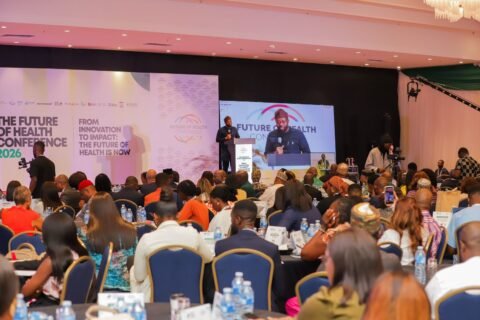
The Future of Health Conference 2026 had a simple central message. An innovation only matters if ordinary Nigerians can afford and access it. Over the course of the event, speakers from government, healthcare, research, technology, and finance shared ideas that could transform how we diagnose, treat, and fund care.
One of the first speakers, and a favorite among the attendees, was not a doctor but a poet, Dike Chukwumerije. He is a writer and founder of the Dike Chukwumerije Center. He made it clear that illness and pain are not abstract concepts but deeply personal to the sufferer.
Although he is not a doctor, he showed how ordinary Nigerian patients communicate with their doctors through metaphors like “my tummy is running.” Beloved double-barreled expressions like “Doctor, my body dey do me sama sama.” This matters because Nigerian doctors understand Nigerian patients: their pains, their diseases, and how they describe pain and unease. It is why we should prioritize the health of our people.
Nigeria suffers from brain drain, where medical professionals leave their home and their people. This affects health financing and leaves us with a shortage of trained staff, a shortage of researchers, and a limited ability to collect and analyze our own data.
The good news is that a counter-trend is also emerging: medical professionals returning to Nigeria. Medical and non-medical professionals alike are developing innovations, practical ideas, products, and services targeted at the ordinary Nigerian patient. However, innovation must translate into impact. Ordinary Nigerians should be able to afford and access these new products and services.
According to Dr. Kelechi Ohiri, Director General of the National Health Insurance Authority (NHIA), we need a health system that is for our people and responsive to our needs. Meeting this goal requires collaboration. The government, healthcare providers, researchers, innovators, communities, development partners, and the private sector each have a role in translating evidence into action.
But who should pay for these new and upcoming innovations: patients out of pocket, insurance, or the government? Core HIV testing and antiretroviral medication remain entirely free at government-approved facilities. Hidden and indirect out-of-pocket costs remain, including administrative and lab fees, ancillary medications, transportation to the clinic, time taken off work, and extra food needed to tolerate heavy medication regimens.
An important issue affecting the scaling of innovations, raised by many speakers at the conference, is the data problem. Dr. Erasmus U. Morah, Senior Adviser at Africa CDC, explained how he and his team fixed a data problem with immense impact. Nigeria’s HIV treatment coverage rose dramatically, from roughly 33% in 2017 to over 85%. This success was driven primarily by more accurate baseline data. By providing the exact geographical layout of the epidemic, the $110 million Nigeria HIV/AIDS Indicator and Impact Survey (NAIIS) served as the foundational “denominator,” correcting past overestimations and redirecting public health infrastructure where it was needed.
Dr. Ify Aniebo, Founder/CEO of Clusta Genomics, is also doing great work on the data problem. Nigeria has the highest malaria burden in the world, and Dr. Aniebo reduced malaria genomic sequencing costs from $150 to $20 per sample. Through her work, policymakers can learn a great deal about antimalarial drug resistance and chat with a dashboard chatbot about malaria in a particular region of Nigeria.
They can use this data to target infections and treatment plans and to make informed decisions. Her work is helpful because, with this antimalarial drug resistance information, ordinary Nigerian patients can be cured on the first attempt rather than wasting time and money on drugs that no longer work.
Another thing that gives an innovation great impact is accessibility, and many innovations discussed at the conference aimed to solve this problem. Ikechukwu Anoke, Co-Founder and CEO of Zuri Health, pledged, along with attendees, to put a doctor in every phone in Nigeria. He also confirmed that Rema, a Level 4 mobile hospital, is on its way to Nigeria and will arrive in 45 days.
An attendee asked whether medication would be distributed freely during outreach. He replied that he is looking for partners, as Rema 4 and 5 are innovations targeted at underserved communities, and that he plans to keep selected or chronic patients on a continuous care program.

Pamela Egbo, Head, Office and Hub Operations at mDoc, highlighted the need to address Nigeria’s chronic disease burden. She described the case of Mrs. O, a patient supporting a large household on a monthly income of ₦30,000. For patients in this demographic, out-of-pocket digital health interventions are structurally unaffordable.
To address this gap, mDoc utilizes a tiered pricing framework paired with a third-party subsidization model. Through a built-in “Gift a Subscription” feature on its plans, outside sponsors—including individuals, philanthropic entities, and NGOs—can directly finance a low-income patient’s access to virtual health coaching. To ensure long-term viability, we should transition this from fragmented funding streams into a sustainable, payer-at-scale model.
Many great innovations were discussed at the conference; many need partnerships and funding to scale and make even more impact. One trend noticed is that investors want to see results first. For example, Medserve had no partners before it showed results and four partners afterward. Funke Falade, Vice President of the Nigeria Sovereign Investment Authority, said that investing in healthcare infrastructure is investing in the productivity and resilience of the Nigerian populace.
According to Folake Owodunni, Co-founder and CEO of Emergency Response Africa, for an innovation to scale, it needs both a doer and a payer. She went on to explain the Mulago model. Before an organization or idea is backed for scale, it must satisfy four core criteria.
An innovation achieves true scalability when it is good enough to solve the core problem with measurable, observable impact, yet big enough to target a widespread issue that justifies mobilizing massive resources. At the same time, the operational delivery model must remain simple enough for external networks to execute seamlessly without constant hand-holding. At the same time, the final cost must stay low enough to remain affordable for the ultimate long-term payer at scale.
To avoid plateauing, innovations must explicitly design their model around who will run it and who will pay for it. To scale sustainably, an innovation must identify its doers-at-scale, a long-term execution network of existing NGO networks, private businesses, or governments rather than a single entity. It must also identify its payers-at-scale, who secure long-term funding through out-of-pocket customer payments, tax-backed government budgets, or institutional “Big Aid,” rather than relying on perpetual small-donor charity.
Back to Mrs. O., who earns ₦30,000 a month and supports a large family. For an innovation to truly serve her, it must pass the “cheap enough” test. It means a payer-at-scale, whether tax-backed government budgets, health insurance through the NHIA, or institutional funding, working together with doers-at-scale who can reach her community. The Future of Health Conference 2026 proves that the innovations, data, and ideas are already in Nigeria; the task now is to make sure the next Mrs. O. does not have to choose between her health and her family.
Ukpong, a freelance health writer, writes from Jos, Nigeria.